Having the Vehicle Towed
We recommend that towing be done only by an Authorized Mazda Dealer or a commercial tow-truck service.
Proper lifting and towing are necessary to prevent damage to the vehicle. Particularly when towing an AWD vehicle, where all the wheels are connected to the drive train, proper transporting of the vehicle is absolutely essential to avoid damaging the drive system. Government and local laws must be followed.
Always tow an AWD vehicle with all four wheels off the ground.
Towing an AWD vehicle with either the front or rear wheels on the ground is dangerous as the drive train could be damaged, or the vehicle could trail away from the tow truck and cause an accident. In addition, depending on the condition of the malfunction or damage, fire may occur due to power generation from the rotating motor. If the drive train has been damaged, transport the vehicle on a flatbed truck.
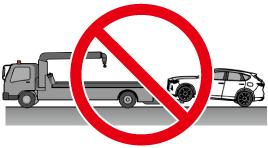


-
Do not tow the vehicle pointed backward with driving wheels on the ground. This may cause internal damage to the transmission.
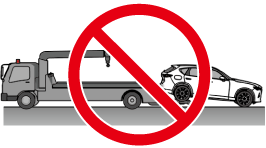
-
Do not tow with sling-type equipment. This could damage your vehicle. Use wheel-lift or flatbed equipment.
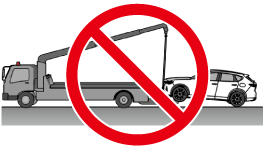
-
If the parking brake cannot be released when towing the vehicle, transport the vehicle with all front and rear wheels raised off the ground as shown in the figure. If the vehicle is towed without raising the wheels off the ground, the brake system could be damaged.
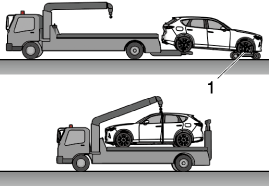
-
Wheel dollies
-
If towing service is not available in an emergency, the vehicle may be towed with all four wheels on the ground using the towing hook at the front of the vehicle.
Refer to Using the Tiedown Hooks (Search).
Only tow the vehicle on paved surfaces for short distances at low speeds.
Follow these instructions when towing the vehicle with all wheels on the ground.
-
Shift to the N position.
-
Switch the vehicle power to ACC or ON.
-
Release the parking brake.
Refer to Electric Parking Brake (EPB) (Search).
Remember that power assist for the brakes and steering will not be available when the hybrid system is not running.